 About gDonna
 The photo is my son and myself. Now days you can get a photo made to look old like this one. This photo was taken when this was the new look.
Harry S Truman was president when I was born and world war II had ended. I grew up in a time when lunch was put in a brown paper bag and a sandwich was wrapped with wax paper. There was no such thing as pantyhose, we wore stockings that attached to the rubbery clippy things that attached to the girdle. Convenience stores were not common and when we took a trip we packed a picnic basket because many places did not have fast food. Highways had places to pull over and stop, some with picnic tables. Read more ....
Comments On Article: What Would You Choose...
If you would like to share your comments for article What would you choose..., this is where to do it!
Click the Reply To This Topic button below to post yours.
Something interesting to consider. Soap.
I use bar soap for hands and hair right now. I only put out liquid hand soap for guests because so many seem to prefer it. It seems to be used up more quickly than bar soap. My grandson was quite interested in the bar soap when he was learning to wash his hands at my house as they only have liquid soap at his house.
I use a powder for clothes and try to use the smallest amount. I also tend to wear clothes several times before I wash them except for underwear.
I've also found that not everything I clean needs soap. Sometimes it just needs a rinse.
I think for the first month I would pick 4 different ones so I'd have some on hand and from then on I'd likely pick the one that was used up most often to create a little supply.
This is all so fascinating! And fun! :) I don't understand the soap rationing, though. If it's per person and you each get a soap choice each week, that sounds like a lot of soap. I looked up the ounces of my soap. My personal soap bars are 3.5 ounces and last a long time (Sappo Hill soaps). My household lye soap for cleaning comes in a five ounce bar (Stewart Crafts), and my soap flakes for laundry come in a 1 pound package that divided in to 3 ounce portions means enough for five weeks (Laundry Evangelist). If the three people in my family get to pick one soap choice each week, meaning three soap choices a week, that's more soap than I could possibly use! I also use a 3.5 ounce shampoo bar (J.R. Liggett), but I guess that doesn't count, though if it did count, that would be a fourth choice of soap that I would need.
Now I have to think about this. :) We have two bathrooms with two personal soap bars (sink and shower) and one shampoo bar in each. That's two week's worth of choices. Even cutting off the extra half-ounce on each bar, I don't think we'd use that much in a month. Do I have unusually long-lasting soap? The shampoo bars "melt" faster than the personal bars, and would have to be replaced more often.
It takes me forever to get through one of my household lye soaps. That's probably because I use -- aha! -- dish soap in a bottle. I forgot about that. And I use a dishwasher. I may have to hand wash all of my dishes with lye soap for the soap rationing, and cut them into 4 ounce pieces. I'll have to measure my soap flakes use in the laundry, but I think three ounces is about what I use in a week.
The rations still seem like a lot of soap.
This was a very interesting post Grandma Donna. I didn't realise that soap was rationed during that time in history, but it makes sense.
I also wanted to just say that I hope you, Charles, your pets and family, all have a very Merry Christmas and a wonderful New Year. I'll look forward to all the things you write in 2026. Many blessings ~ Linda (NZ)
Stephanie G, I love my Sappo Hill soaps! I have to use natural soaps and I found these to be the most economical too.
As you describe it, it does seem like plenty of soap.
Sorry, this is going to be rather long - please bear with me. The soap rationing was certainly complicated - and one of the reasons why I admire my mother's and grandmother's generation as they navigated the ration and points systems during WW2.
So - let's take my mother's family as an example:
Living at home were my grandmother, my war-disabled grandfather, my mother and her younger sister.
So it would seem that in every four week period, my grandmother could have had the following (assuming of course that it was available - not always the case, remember!)
A 3oz bar of toilet soap each
4 oz household soap each
3 oz soap flakes each (or 6oz soft soap)
6 oz soap powder each (or 1/2oz liquid soap)
It does sound a lot but remember - homes were usually heated by coal and gas, and the general environment was dirtier, so the home and what one wore tended to get grubbier than nowadays - I can remember the collar of my white school blouse being dirty after one wearing and I was a very clean child - the Clean Air Acts from 1956 onwards made a great difference of course.
There were no dishwashers, washing machines were by no means universal (mostly owned by the well-off) and most people were very careful not to waste the fuel to heat water (hence the painted line in the bath at the 5" level, even for the Royal Family). Depending on where one lived, the hardness of the water would determine how much soap you would use.
The other thing to remember is the cost - income tax had risen in 1938 to 27.5% (5 shillings and sixpence in the pound) and continued to rise, bringing many more people into paying tax as the annual (non-taxed) personal allowance was reduced from £100 to £80 for a single person and from £180 to £140 for married men. Disposable income levels for many meant deciding whether to buy all one's soap entitlement, or to put that money towards food and rent (many did not own their homes and renting was common). Also, although women entering the labour market for war work had their own taxable allowance, it was set against their husband's income - and if he had used up all his personal allowance, their income was taxed too!
When Laura and I attend 1940s events as the Home Front Kitchen Girls, visitors often seem surprised to realise that although things were rationed and prices were fixed, one still had to be able to afford to buy them. I imagine that my grandmother, with only what she could bring in from her cleaning jobs, my mother's wages at the Telephone Exchange and my grandfather's WW1 disability pension, must have been an incredibly resourceful woman!
Grandma Donna Wrote,
Pamela N, I am so happy to see you comment on this subject. :) My brain has been in overtime thinking about the soap ration. I keep thinking about this time in history when the products and lack of products we have today and all of the factors that are so much more than soap. I feel that taking all of the soap and products away from our bathroom, kitchen and area that we keep cleaning soap and then set the ration soap out we would start getting a better idea. I feel that people would have gotten dirtier during the 1940s and other times in history with gardening and cleaning and especially the soot.
Also, many women were doing a mans work plus a woman's work. Children got dirtier because they played outside which would have required more scrubbing. You are very right about the no dishwasher and a large percentage of people did not have a washer.
Thank you for the reminder of those times when we they may have had the coupon but the supply may not have been there to purchase or the income to purchase. This is the the most difficult of a history study, the real time facts and shortages and such as that. Just because they had a coupon for any of the rationed items did not mean it was available to purchase and a coupon did not pay for that item. It is difficult to imagine what it was like for them to menu plan, and work the budget during these times because they could not just flip out a credit card and purchase something they wanted.
Charles and I recently faced a situation over fish. We were going to buy fish on our grocery shopping day and the price of fresh fish hit us in the face! We though of other types of fish, and looked at frozen fish, and then the canned and decided that we would be leaving the store without fish. We passed a fast food fish place on the way home and when we got home I looked up their online menu to see the price of their fish and I gasped! Our retirement budget and the studies has change the decisions we make. Thank you Pamela for any information that you have to share on this study. Hugs :) Donna
Laura and I discovered how difficult it was to attempt to replicate the rationing experience when we spent those two weeks on 1942 rations back in July - keeping up with when the points allocations changed and when ration amounts altered because of gluts (cheese being a prime example - the cheese ration was increased to 8oz a week for a few heady months and continued into the first couple of weeks of January 1943).
Laura and I will be spending another couple of weeks on rations in January, to demonstrate the difference between managing in the summer as we did and what we would be eating in the winter. There were a good many dishes that we didn't try as they were definitely more suitable for the colder months.
As for soap - well, I used to make my own castile soap for personal use but now I buy it (oil + lye + a tiny kitchen + four nosey Maine Coons = a bad combination). I did try using Sunlight in a soap cage for washing up and as the water in my bit of Devon is very soft, it works well, though I need to get another soap cage (Laura pinched mine for our 1940s collection, along with the glass washboard and the tin tub). I wonder whether the top loading machines that you have in the USA work better with soap flakes than my front loader does?
This didnt sound like a lot of soap until I realised I could have 5x that amount in a month. That makes things easier! We have a lot of laundry and dishes to go through.
I dont know what soap powder is, but 6 oz sounds like a good deal. However, hard soap combined with borax and washing soda could make more than 6 oz of laundry soap, theoretically. So I would think:
4 oz hard soap, for making laundry detergent
Then I will take 3x 3 oz bars of 'toilet soap' 2 being castile, and the others goats milk or other gentle soap
The castile soap is for household cleaning, dishes, and handwashing. The Goats Milk soap is for the body. It could also be any nice scented soap, as I have a few options. It just has to be a gentle real soap, with glycerin and the likes.
I could switch it around and get two bars of Goats Milk, and have it for handwashing too. Depends on how my skin feels. Castile should be fine, as any real and gentle soap does the trick (for handwashing). But Goats Milk for personal hygiene, always. I really need something especially gentle and moisturizing for my super sensitive skin.
This was a real brain exercise!
For 4 more people, my only idea is having another 2 bars of handwashing soap, then 2 more laundry bars. And some more for dishwashing. Then personal hygiene. But dont ask me the numbers, or my head will spin. :P
16 more bars of soap... my goodness... I am sure we could go through it, considering the air quality at the time.
Edit for typos
We have used Kirk's unscented bar soap and liquid hand soap for years. Whenever we find it on sale, at Vitacost, we have stocked up. If rationing occurred we would have some extra, but we would choose the Kirk's for body hair and some cleaning. A Castile soap is very versatile.
Vinegar is an excellent fabric softener and we use it in each wash. For clothes that are not dirty and just need a good rinse, we leave out the soap and just use the vinegar in the fabric softener section of our he washer. For hand washing it would work as well, but wear gloves as vinegar is acidic. Vinegar is also very easy to make from scratch. 1n 1942, fragile or extremely delicate fabrics would have been limited to the very wealthy.
I, also, make a house cleaner out of washing soda, a tsp of dishsoap, vinegar, boiling water and two essential oils that have antibacterial and cleaning properties. In 1942, I would get the ration of soda, have homemade vinegar, use some finely grated Kirk's soap and have the oils I had made from garden herbs grown in my victory garden. It is a liquid soap, obviously, and the finely grated Kirk's would dissolve with the boiling water.
Hydrogen peroxide bleach is a wonderful cleaner, also, with no smell. A tsp. in a gallon if water is good for extra dirty spaces.
2 ounces of loose leaf tea will hardly last one person for the week, but four ounces will supply two pots a day for the two of us, and of course we top up the pot with boiling water for a second cup. Strangely, British children did not get a tea ration.
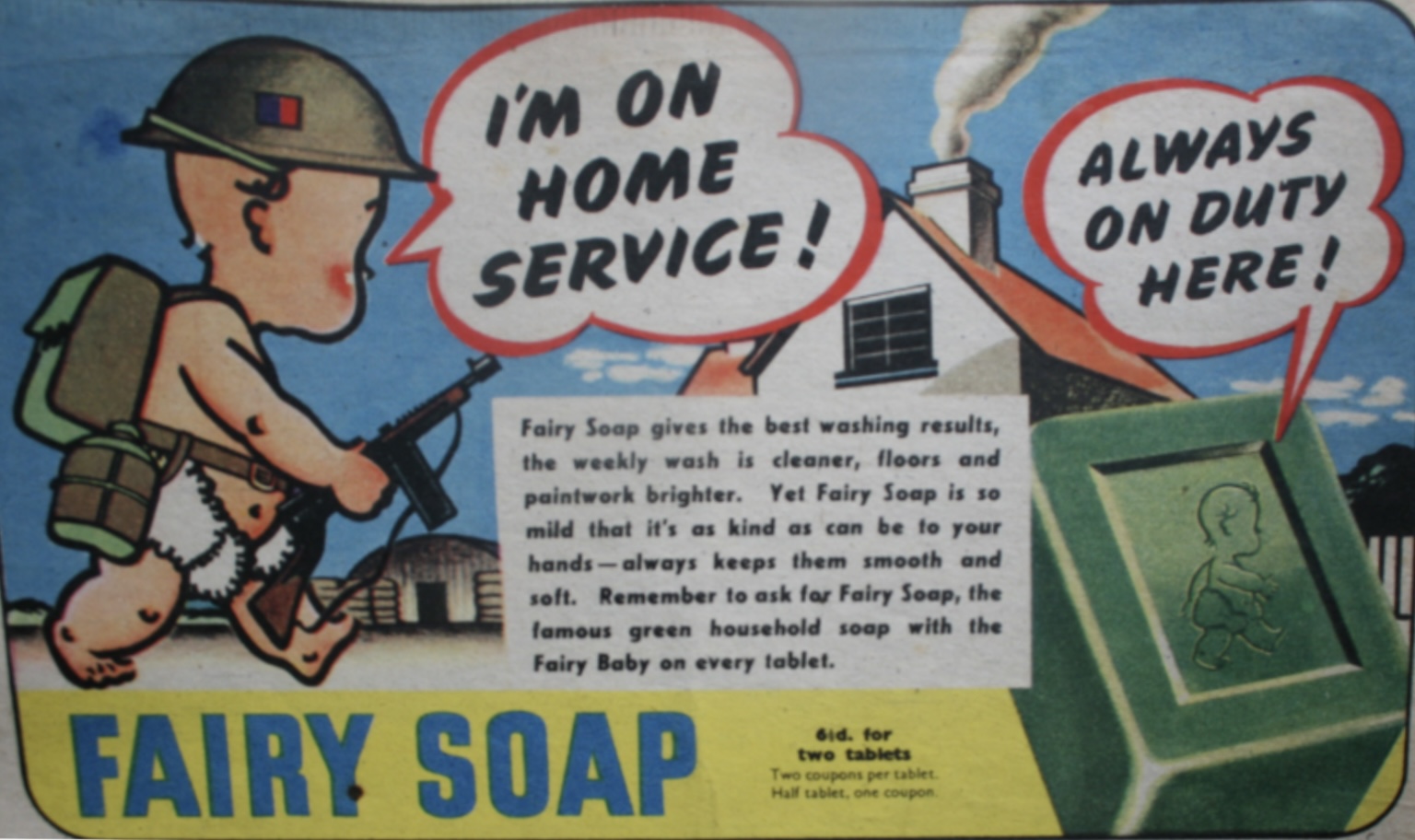
It is the same with soap, the ration is barely enough for one. The household soap was used for the laundry, the dishwashing, and all of the cleaning. The quarry tiled floors were scrubbed with soap and water. There was a very limited choice of soap available in the war, manufacturers started to place advertisements saying that their soap was longer lasting.
Those better off would sent clothes and household linens to the local laundry. Vintage linens often have embroidered or permanent black ink laundry marks.
We use unscented, pure soap bars for the laundry still, grated and boiled, with washing soda and borax substitute added.
We had green laundry soap or deep pink carbolic soap at the village school. The cleaner would chop chunks off the long block with the coal shovel. The boy who swore at the headmistress, got his mouth washed out with the carbolic and came back into class with wet hair, streaming eyes, and looking rather sick.
We did use less soap of course. Saturday was bath night, and the rest of the week was more of a, “lick and a promise.” Our parents had plumbing and a small bathroom fitted in on the ground floor, though it was not part of the original Victorian house, the privy, changed to a flush toilet when the village got mains drain, was still in the outhouse. One did not linger in an unheated room in winter.
Old herbal recipes were used to help with the WW2 soap shortage. Ivy leaves, horse chestnuts, soapwort, and the very invasive plant, Mares Tails, could be used to make free soapy liquid. They are all abundant here, it was a coal mining area with a lot of industry.
The air in industrial cities was thick with the pollution from coal fires and steam engines, which blackened the buildings and blew black smuts in through the windows and onto curtains. The London smog, so thick it was called the pea souper, was infamous, killing thousands. During The Blitz, diarists for Mass Observation record the smoke from many burning buildings and the smell of cordite from explosives. Also the air in homes, offices, pubs, cinemas, everywhere was thick with cigarette and pipe smoke, something we have been glad to forget.
I'm very interested in reading old newspapers to start my own study. How do you find them? Are they free?
Thank you for any help.
Lori
Most months I wouldn't need to choose any, because that is a lot more total soap than I go through in a month.
When I did run low I guess it would usually be powder #1 or #2 because I'm thinking one of those was for dishes? (Presumably if I lived in 1940's UK I would know that!) I don't know how far 6 or 12 ounces of those powders would go, but in real life it takes me between 18 months and two years to go through a 26 ounce bottle of liquid dish soap, so let's say around an ounce and a half a month. And I don't just use it for dishes but also for general purpose things like washing my car, cleaning chainsaw chains, et cetera. Even when I used to use it for laundry and shampoo as well, a bottle would still last over a year, so that would have been about 2 ounces a month. I can't see possibly using 6 ounces of powder a month, much less 6 of one and 12 of the other.
For hand washing and showers I use Ivory bar soap, and each 3.17 ounce bar (not much over ration size) normally lasts around 6 months if well cured. This is with my normally frugal habits, but not with any particular effort to conserve soap.
I don't use soap at all anymore for laundry or shampooing my hair, instead I use homemade lye water from wood ashes. It actually works better than soap with my very hard well water, and it's free and eco-friendly. I like that it rinses out cleanly and doesn't leave any soapy odor on fabric, and was shocked by how well it lathers in my hair and how gentle it actually is. I don't even need conditioner after use.
Pamela N -- thank you for all of that information! It gives me a much better feel for the time period. :) When you mentioned the family grouping, it made me realize that my husband would probably be off at war, so it's only two choices per week. My home is well insulated and has lots of carpet that I'm trying to get rid of for flooring instead. Carpet doesn't need soap like flooring does. Dirt doesn't get in a well-insulated home as much. I think women did a lot more repetitive daily housework back then too. I washed my walls this year before painting them, but I don't wash them regularly. I think wall and cupboard washing was more frequent in the past, so lots more soap use then. Not having hot water definitely reduces soap's effectiveness, and not having enough money definitely reduces the soap amounts!
I have a front-loader washer and the soap flakes I buy work beautifully in it, but they are a proprietary formula from a small shop. For years I made my own laundry soap, but these soap flakes work better than anything I have ever used, soap or detergent!
margaret p -- I buy the 12-pack of Sappo Hill soaps and in the plain, not fancy scents, and it's very economical that way! Ivory and Kirk's and many others bother my skin, but not Sappo Hill.
I hope you're feeling better. :)
The two types of powder were washing powders, though Rinso could be used for washing up as well as laundry, so presumably the other product (I think it was Persil 'for the whitest wash') could as well.
Rinso was marketed as 'no boiling needed', which was a huge advantage when it came to fuel saving. We have reproduction packages for our Home Front display - the Sylvan soap flakes were for stockings and woollens and the Sunlight soap was the yellow household one, though you could grate it up and use it for clothes along with the Borax and washing soda.


Pamela N.,
Thanks for sharing the package images. So am I understanding correctly that when Rinso says it "Does your washing up too!" this is a British term for washing dishes? (Here we use "washing up" to mean washing one's hands and sometimes face at the bathroom sink, especially after dirty outdoor work, before sitting down to dinner.) But if it means washing dishes, then that's the one I'd choose because it says no boiling needed. I don't use a water heater and wouldn't want to have to boil water. So I would buy that and a three ounce bar of toilet soap maybe twice a year.
Also I just remembered I do use herbal dog shampoo for work. I was only thinking about household use. Not sure dog shampoo was even a thing in the 1940's, but I guess if there were professional groomers, they could have used un-rationed human shampoo on the dogs. Or maybe gotten a special business ration of soap like bakeries got sugar. Although it might not have been considered exactly an essential industry:)
Yes - I'd forgotten that 'washing up' means something different in the USA! We 'do the washing up' after a meal (or at least, my husband does - I cook, he clears up ????).
I think the 'no boiling' refers to not needing boiling water to clean very dirty clothing - those who didn't have washing machines (and they were very few and far between) might have had a 'copper' that had a heater underneath, housed in an outhouse and would use boiling hot water to wash pretty much everything except delicate items and woollens. My paternal grandmother lived in a rural area and that was how she washed clothes/sheets/grandad's shirts. I can remember helping her to wring clothes out with a mangle and being warned to keep my fingers away from the rubber rollers!
Other people would use a tin bath and as Janet W says, those who could afford it would send their washing out to the laundry (my great-grandmother was noted on the 1901 census as a 'laundress').
My own mother didn't have a washing machine until the mid-1970s and before that all the washing was done by hand, smaller stuff in the kitchen sink and sheets etc in the bath. It wasn't lack of money, it was lack of space until my parents extended the kitchen and had somewhere to put a washing machine. I know people in the US are often surprised to see a washing machine in UK kitchens, but our homes rarely had utility rooms. I did manage to squeeze a machine into our tiny downstairs loo, but our old farm-worker's cottage dates from 1740, and space is a premium! I imagine that the women who lived here in centuries gone by may have had a tin bath, if not a copper!
I don’t remember my mother ever mentioning that soap was rationed so this was interesting news to me! I currently make my own laundry detergent just like Gdonna makes hers but I have used English ivy before and it worked. I think I would choose Kirk’s or Ivory and the soap to make laundry soap but the rest, goodness, I am not sure! I wash my hair with Liggett’s but I could probably use Kirk’s.
My dad worked at a tire recapping shop until he left for the war in the 40’s. He told us how people were told to use tires completely up. The government had rubber drives to collect rubber. My mother’s sister donated her old girdle and the men collecting rubber flew that girdle like a banner on their collection truck! My aunt was so embarrassed but of course, no one else knew it was hers.
We had a coal furnace when I was growing up and I can attest to the soot it spread in the house. When my dad had to break out a “clinker” we had to cover all the floor vents, but we still blew black out of our noses for a few days afterwards. Our house needed regular cleaning.
Thanks for the new post
I opened a Christmas club account today so I'd have cash for next Christmas, plus a little interest. I like the old ways. :)
I'm thinking - knowing really - that you wouldn't have had a choice in what kind/brand of soap you got, it'd just be what the grocer had available so take it or leave it - and back then soap was soap, none of the fancy gentle this and that stuff you can buy these days. I know from many sources that when people were asked what was one of the most precious commodities you needed during the war years, the answer was almost every time 'soap' - even now, we're warned to keep a good supply of soap on hand, for some reason.
Washing machines, even for the rich, were virtually unknown here during those years, my mum didn't have one herself until 1970 after she'd used my twin tub a couple of times and found it useful. She always rose at the crack of dawn every Saturday morning, lit the fire under the copper and started the washing - I used to take my girls' nappies (diapers) out there every week to boil up in the copper too. I can still smell the steamy atmosphere in the laundry.
I've been thinking about this more, trying to reconcile the idea of there being a shortage of soap with the idea of it being "rationed" to several, several times what I could possibly use in a month. Not even if I were using it for laundry. Not even if I took daily bubble baths. It just sounds like an insane amount of soap to me.
But maybe the issue was that stores would run out before everyone got some, so people would try to stock up when they could? If I had been out of soap for weeks and then finally found it, and didn't know when it would be available again, I might want to buy that much just to ensure I didn't need to think about it again for a year. So maybe the ration amounts were taking into account that not everyone would get lucky with finding it every month, and aimed at allowing a reasonable amount of stocking up when one did find it. You could buy six months or a year's worth at a time, but you couldn't, say, clear out the entire inventory in order to resell on the black market.
It still seems super high compared to the truly tight rations on things like sugar, tea, cheese.
Grandma Donna wrote,
A bit more history, the United Kingdom was in active combat during ww2 before the United States became involved. Germany, Italy, U. K. France and Russia started fighting in 1939 and the United States in 1941.
The U.K. and other countries started fighting and rationing before the United States started their rationing. UK started rationing goods January 1940, the UK started rationing soap February 1942.
The United States, Australia, New Zealand, Canada, India, Burma, Turkey, Spain and Portugal sent crucial supplies to the UK. Getting supplies was hampered due to attacks on ships. Rationing was more intense in the U.K. than it was in the U.S. Besides rationing, citizens were asked to cut back on use of many items that were not rationed, it was for the war effort.
The U.K. Rationed soap but the U.S. did not, however the citizens were being asked to conserve, rumors had started about soap rationing and people were starting to panic. During this study Charles and I will be rationing required by the United states ration books, we will also be rationing some of the goods that the UK was rationing. The United States started issuing ration book May 1942, starting with sugar, followed by gasoline, tires food and so on.
The United States started collecting cooking grease in 1942, the American Fat salvage campaign. They urged housewives to save fats for glycerin that was needed for explosives.
So this study we are trying to get the feel of what all was needed for us to do, rationing, or simply trying our best to conserve for the war effort. :) Donna
The hard milled soap would last longer if kept dry between usages, however it would weigh more so possibly would not last longer than the larger size of soft soaps which would weigh less. Another puzzle for housewives to figure out.
Even though soap was not rationed, fats were and fats are needed to make soap. That might mean less soap was available in stores. Also, as mentioned by someone above, soaps did not have extra ingredients so might have needed more to be useful. I think Rinso was a bluing used in rinse water to make whites look whiter hence no need to boil.
My family through those years lived mostly rural or at least in small towns so farm products were available. I'm not sure of rules concerning home butchering and the lard produced, but if farmers could keep it, then it would have trickled into town as a trade or to a relative. My grandfather ran a gas station and provided gas, kerosene and fuel oil for lighting and heating to farms and I'm sure he was not adverse to a trade. Kerosene was also used for cooking, and I recall my mom had a kerosene stove before we moved to town when I was three.
Water is an excellent cleaner without soap but likely would require more effort. A kitchen floor scrubbed on hands and knees with a scrub brush and water would be decently clean. Vinegar diluted with water is a good cleaner.
Also, remember that Saturday night baths were a thing and the rest of the week you'd just wash up with a basin. I recall Saturday hair washing ... a dishpan of warm water to wash ... a second dishpan of water to rinse ... then second person would use your rinse water for washing ... fresh water for rinsing ... repeat until everyone's hair was done.
It was common to have a wash basin by the back door, and the water would be filthy before it was changed. I still cringe when I think of having to wash up in that basin. You'd come in from the privy or choring and wash your hands and sometimes I felt like I was dirtier than before washing. When every ounce of water was pumped by hand and carried into the house and dirty water carried back out, well let's just say things would not meet today's sanitation standards.
I just wanted to say that I'm enjoying this discussion! Soap is a tough one for me because I have allergy issues. My first option is from a local farm that makes goat's milk soap and lotion. I probably would have scratched a lot during WW2!
I love Pear's soap for face and body. They have the original and a few other varieties. I believe one is mint. Pear's soap has been around for ages, and I can normally find it at our Dollar Tree for $1.25 per box. I have psoriasis and rosacea, and Pear's doesn't bother me.
I know it's not a proper cleanser, but I also love Pond's cold cream. It's very soothing for my rosacea and gets rid of makeup beautifully.
For stain remover, I stand by the big pink bar, Zote. It's a workhorse and lasts forever. If it doesn't get a stain out, it's not coming out at all lol
This soap discussion is fascinating! I too thought that was a lot of soap when I read the post, but there are many points raised here in the forum that show it likely wasn't. My Mum would buy a bar of the original Pears soap for a treat for us growing up, and I still love it to this day, though only buy it occasionally. One thing my Mum would do to make soap last longer was leave bars unopened in the linen press (cupboard) where she stored all the spare sheets and towels. It made the linen smell lovely, and would allow the soap bars to harden and dry out a bit before use, which made them last longer. My standard for laundry is the homemade liquid like GDonna makes, but I use grated Sard Wonder Soap as well as Sunlight Soap for making it up. I have a soap cage and need to get back to using that for my dishes. It's amazing how long a bar of soap lasts in that thing and dishes are still clean to a very acceptable standard. I wonder if our Sard in Australia is like your Zote in the US. Does anyone here know?
I pray everyone has a blessed Christmas celebration! See you on the other side!
Thanks for another fine post! So, if you were starting from scratch at the beginning of the soap rationing, it seems like the first week you would have to buy your toilet soap so you could get your body and hair clean. But then you'd also have to use it for other purposes the first week if you were starting from scratch and didn't have any other soap. Then it seems like in the second week, you would have to get an all-purpose cleaning soap to clean everything, maybe powder no.1, so you could wash baby things and more delicate items. I guess by week 3, you could choose another type of soap. It would be interesting to do the soap rationing to see how it all works out. Maybe since this was soap instead of detergent you needed to use more of it.
The article discussed how much soap you could get in powder no. 1 and powder no. 2. Since you could get twice as much powder no. 2, I wondered what the difference was, so I asked Chat GPT, and here is what it said:
Soap Powder No. 1 (Higher-quality, fat-based)
What it was
- Made largely from real soap, which required animal fats or vegetable oils
- These fats were critically scarce during the war (also needed for food, explosives, and industry)
How it performed
- Better cleaning power
- Worked reasonably well in hot and moderately hard water
- Gentler on fabrics and skin
Why rationed more strictly
- Because it used valuable fats, people were allowed only 6 ounces
???? Soap Powder No. 2 (Low-fat, synthetic substitute)
What it was
- Contained much less real soap
-
Bulked up with:
- Alkalis (like washing soda)
- Fillers
- Early synthetic detergents
- Designed to save fats, not to be pleasant
How it performed
- Needed more powder to do the same job
- Harsher on hands and clothes
- Less effective in cold or hard water
- Could leave residue or stiff fabrics
Why allowance was higher
- Because it used fewer scarce ingredients, households could have 12 ounces
???? Why Britain did this
Soap production depended on:
- Animal fats (also needed for margarine, glycerin, explosives)
- Imported oils (disrupted by U-boats)
So Britain:
- Reserved higher-quality soap for essential needs
- Encouraged widespread use of inferior substitutes
- Allowed more quantity of the weaker product to keep people clean enough for health
???? In everyday terms (how people understood it)
Contemporary British households often described it like this:
- No. 1 = “proper soap powder”
- No. 2 = “make-do washing stuff”
Many people saved No. 1 for:
- Baby clothes
- Underwear
- Sundays
And used No. 2 for:
- Work clothes
- Sheets
- Heavy laundry
I know some people would never have had any extras of anything included soap when the rationing started. This is still true today.
But farm families and others that made their own soap probably would have had a good supply. Most people made soap after butchering and made enough for a year. That soap would be left to cure for a year while they used what they'd made the year before. Lye soap requires seasoning and was often used for everything.
That would also be the case for food as most raised their own and stored or canned it and when WWII started in December, they would have had a year's supply on-hand. The majority of people in town would also have had a big garden so would have had canned or stored foods. Flour, sugar, coffee, tea, oatmeal and rice would have been what was needed from the stores.
My mom's family farmed in the rural south during this time period. I know that the black market provided the community with items they couldn't otherwise get.
I'm pretty sure that you couldn't buy six month's worth of soap at a time because only four coupons were issued per person each month, were valid only in that month and couldn't be 'carried forward'. This would be the same as coupons for other rationed commodities (bacon, cheese, butter, margarine, cooking fat, sugar, tea, jam, sweets/confectionery and meat). If you didn't take your bacon ration in the given week, for example, you couldn't 'carry it forward'.
The only time you might get more than one week's ration would be when the weekly ration amount was severely reduced so it made it difficult to fulfill- as an example, when cheese went to 1oz/week, it would have been daft for the grocer to attempt to cut just 1oz, so if you were a single person, they would cut 4oz and then cancel all four week's cheese coupons in your book. Because paper and packaging was also at a premium, it is unlikely you would have been issued just 2oz of loose tea each week, but would have had 8oz and all four tea coupons cancelled. Obviously, if you were shopping for more than one person, it was a bit easier.
The points system worked differently - these were for foods where the supply could not be guaranteed (think tinned meats, beans, fruit etc coming in from the USA/Canada). One could use the points at any time in the four week period and at any shop - unlike the rations where you had to designate a grocer, butcher, etc. If there was a lot of Spam available, it would require, say, 16 points/1lb can, but if less was available, the points would go up to, say, 32 points/1lb can. Given that one usually only had 20 points per person per 4 week period, choosing what to use those points on was very important - in the months before Christmas, dried fruit would be bought with those precious points so that mincemeat and Christmas Cakes/puddings might still be made.
If anyone is interested in UK rationing from the point of view of the grocer and how they managed to supply their customers, this is an excellent first-hand account -
'The View from the Corner Shop - The Diary of a Yorkshire Shop Assistant in Wartime' written by Kathleen Hey. It is available on Kindle as well as print - this is Amazon's description:
"Kathleen Hey spent the war years helping her sister and brother-in-law run a grocery shop in the Yorkshire town of Dewsbury. From July 1941 to July 1946 she kept a diary for the Mass-Observation project, recording the thoughts and concerns of the people who used the shop. What makes Kathleen's account such a vivid and compelling read is the immediacy of her writing. People were pulling together on the surface ('Bert has painted the V-sign on the shop door…', she writes) but there are plenty of tensions underneath. The shortage of food and the extreme difficulty of obtaining it is a constant thread, which dominates conversation in the town, more so even than the danger of bombardment and the war itself. Sometimes events take a comic turn. A lack of onions provokes outrage among her customers, and Kathleen writes, 'I believe they think we have secret onion orgies at night and use them all up.' The Brooke Bond tea rep complains that tea need not be rationed at all if supply ships were not filled with 'useless goods' such as Corn Flakes, and there is a long-running saga about the non-arrival of Smedley's peas.
Hello Grandma Donna,
thank you for your wonderful website. I look forward to every new post.
I wish you and Charles a Merry Christmas and a few peaceful and relaxing days.
Warm greetings from Germany,
Sibylle
Pamela N.,
I think you misunderstood what I meant about buying six months worth of soap when it was available. I totally understand that the ration coupons were only good for the month they were issued in.
I meant that a three ounce bar of toilet soap and 6 ounces of powder would be six months worth of soap for me, and only take two coupons. For all four coupons, I could get a year's worth in a month, and throw the ration coupons away for the next 11 months. And I don't even feel like soap is something I'm intentionally frugal with. It's just soap. When I need it I use it.
If it was per household I could see people with lots of children going through that much or more, especially with babies in diapers, but per person? It still sounds like a lot to me, but *shrug* maybe some people just use far more than I ever realized.
If that's true, I could have bought extra soap and then secretly traded it to my neighbors for part of their sugar ration, hehe. One time I tried to do (American) sugar rationing along with one of these studies, but my SCOBYs alone needed more sugar than that, and not wanting to risk their health, I had to quit the study.
Ann W.,
What you wrote about "things would not meet today's sanitation standards" made me smile because I too spent my early childhood in a home without indoor plumbing, and the infrequent baths and all don't bother me but you know what does in hindsight? We had a drinking water pail with a dipper in it, and everyone would drink directly from the dipper, then drop it back in the pail. Even friends and neighbors when they were over. No one around there seemed to have a problem with that at the time. Now, especially remembering some of those neighbors, I'm fairly disgusted by the memory. I won't even drink after family!
All of the studies are valuable, but this one is going to be far more interesting than I thought. :) We're certainly going to see how easy the US had it compared to Europe! We didn't have any soap rationing in the US, and we had an adequate supply. The soap rations look reasonable. I think it was the lack of availability that was the real problem.
If we're following the real-time dates in the 1942 newspapers, the first thing that gets rationed for me is tires and cars in January. We don't need to buy a car, and my husband said we don't need new tires next year, so I'm good there. Gas rationing later seems to be tied to how many tires you have. Really, this is going to be a fascinating study. :) I think I'll do a month of soap rationing in February when the soap rations go into effect and try to do a lot of extra cleaning with household soap! I'll experiment with using different kinds of soap for different kinds of cleaning too, just as if I was out of the regular soap for that task due to shortages.
Ahhh - understood! Yes, I think the reason for the amount of soap (which clearly if you were buying for a family rather than a single person does seem a lot) may be because homes were more likely to get grubby, given the air pollution in towns and cities. Accounts by maids in the 19th century attest to the amount of soot/dust/dirt in homes and little had changed regarding heating in many houses in the UK by the 1940s. It was also a point of pride in many neighbourhoods to have a well-scrubbed doorstep and the pavement outside the house washed down. I remember Ruth Goodman in the 'Wartime Farm' programme being pleased that she had linoleum in the kitchen as it was easier to keep clean than flagstone floors. As for other rooms, fitted carpets weren't really a 'thing' - my grannie actually thought they were 'unwholesome' as you couldn't take them outside to give them a good beating. ????
Single people, as often the case, really had to think hard, however - 3oz of soap powder is only enough for one washday (you'd be saving up your washing to do it in one go, if you could), so you'd use hard soap (household soap) for washing and find other ways to clean things - such as salt for the table and wooden surfaces in the kitchen, vinegar for cleaning paintwork, also glasses, windows and so on, and you would save slivers of soap and make that into a form of soft soap by putting them into a jar with warm water (good for washing dishes or woollens and delicates).
Amazon wanted almost $20 for The View from the Corner Shop, so I got it from Abe Books for $6.49, and no shipping costs.
Oh. Pamela, I enjoyed this book! I have it. Very interesting to see the merchant's point of view. I got a chuckle over the hidden onions, I think it was! I would recommend it.
Grandma Donna Wrote,
After removing every bit of soap from every location in our home, I then pondered of which soap I need. This changes things.
*Note, Soap ration stamps expired, so what one did not use in their months rations could not be used later (again factor in could they afford to purchase their 4 choice?) This answers the question you may wonder, what did I choose after removing all of my soap? I still have not decided, it is complicated, because we live in this modern time with so much available and we have to consider again, the very early 1940s.
When rationing started, people would have had some soap but maybe not so much as one would think considering the time and the events happening. Something I noticed in my UK research, the newspaper notice about soap was sudden. The articles stated, Soap rationing starts today, or soap is now rationed. I am not certain if this was intentional so that there was not a sudden buy out of soap. This will need more research.
My Kitchen sink is an interesting situation for I did have different types of soap. Right now I have one bar of soap at my sink and everything is cleared above and under my sink so there is no temptation.
I did read in the microfilm newspapers that there was not going to be a ration on liquid soap "but" then there was. Bar soap was far more common in 1942. Liquid soap would not have been the liquid soap we know today in 1941 or 1942. Swan soap was a new soap on the market in 1941 to compete with Ivory and was also a floating soap. *Edit for spelling mistake.
*Note, Dr. Bronners was founded in 1948.
Just some updates, Donna
Grandma Donna Wrote,
Stephanie G,
We just read in the 1941 newspaper that if one had a refurbished tire they were not allowed to drive over 35 miles per hour. Also speed limits were lowered during the war to save on fuel.
Charles family would talk about how they wrapped their tires during the war and drove slow. They used all kinds of things around their tires, even fabric! I have this vision in my mind the cars going down the road with all sorts of things wrapped around the tires.
In the news were stories about some people would remove their tires and bring them in the house so no one would steel them. People would jack up their cars and set them on blocks, lock their cars inside garages. These stories were here in the United States. Donna
Grandma Donna - yes, to avoid panic buying, the soap rationing was kept secret until the morning of the announcement. The Ministry of Food rather dropped the ball in March 1942, when they announced that only the National (wholemeal) loaf would be made but not actually doing it until April! Naturally, women rushed to stock up with white flour which soon became a rarity in any case, as mills were required to make the most of the wheat that was grown or brought in at great risk by the merchant ships from Canada and the US - hence a minimum 85% extraction flour, rather than the 72% extraction that produces white flour
Although the National Loaf was probably a rather healthier option, it soon became dubbed as 'Hitler's Secret Weapon' for it was much disliked. I have made and eaten it, and without the little bit of white bread flour that I usually use in wholemeal bread, it is heavy going!
I wonder how many households would actually grind their own wheat berries back then? Wheat berries and other whole grains last for many, many years when stored in a dark, cool, dry area. Flour has a much shorter life span. Pamela's comment started me thinking about old time wheat grinders. In The Long Winter, ma Ingles and Laura take turns grinding the wheat berries in order to survive. I would imagine they had one grinder that was used for both coffee and grains; even possibly herbs.
I grind our grains and we store them in ideal conditions long term. Since the Depression was just winding down I would venture to guess not many had whole grains unless they farmed. My MIL told us that during the Depression there was plenty, if anyone had the money to buy it. My paternal grandparents bought a grocery store and a beautiful old home in 1937. I will see if I can find the sale document, for the cost, in my stacks and stacks of genealogy. I would imagine bargains were to be had then, but I might be wrong.
If a person had the money and if the soap was available, then purchasing it to use as a trade item probably would have happened. Buying legally would not be black market, but would trading or selling it have been considered illegal?
I'm allergic to most soaps and use Ivory exclusively. A small bar lasts me about 6 weeks for the shower. I use liquid soap at all sinks and use only a small (less than marble sized) amount each usage. Liquid soap can be made by soaking bar soap until it liquefies.
When you look at recipes during rationing, you see a lot of raisins. One cookie recipe had you boiling raisins and using both the liquid and raisins in the recipe. I have one of my grandmother's recipes for oatmeal raisin cookies that only has 1/2 cup sugar in the whole batch. It does use a full cup of shortening though. Grandma lived on a farm, so they had their own lard.
I'm pretty sure the reselling or trading part would be considered black market, and even using rations to purchase items for friends was forbidden. (Or at least in the US it was.) On the other hand you hear stories of neighbors all pitching in rationed ingredients for a wedding cake or something, and it seems authorities looked the other way on that. (Would have been horrible public relations to crack down on it, no doubt!)
For years I made 100% whole wheat bread out of wheat I ground myself. I used an overnight recipe with 3 cups fresh ground flour, 1/4 tsp dry yeast, 2 tsp salt, and enough water to bring the dough together. The first rise, either on the counter or in the fridge depending on the weather, lasted about 18 hours. It always made light, delicious whole wheat bread. Even if I added some oatmeal or barley, it still came out nice. I never understood why the National Loaf had to be so hated, and assumed it was the difference between 1940s' bread recipe customs and modern methods.
There was a sort of 'grey market' - pretty sure that people who didn't take sugar in their tea would pass over some of their sugar ration for something that a neighbour had, and swapping fresh vegetables or fruit for eggs with a neighbour who kept hens would be common. There was a fair bit of bartering between folk living in rural areas and those in towns and what was usually traded would be eggs, butter, rabbit, game birds and poultry. There were special egg boxes that could be sent in the post - Laura and I have a reproduction one - and surprisingly, those eggs always got to their intended recipient!
Dried fruit was on points, so a family might pool their points to make a wedding cake and the government did have a very small extra allowance for weddings and funerals. No more than 40 guests/mourners with an extra 1/4 oz of butter and 1/8 oz of sugar per person and 1 pint of milk per 20 people. 

This is the National Loaf recipe that I have used - it makes a very 'worthy' loaf. The amount of salt seems excessive but was to make the bread last longer. In addition, bakers could only sell day-old bread, not fresh bread, and they couldn't sell it sliced or wrapped. It was described as grey and dense - and presumably the flour that bakers used had additions of calcium and vitamins. The recipe I use obviously doesn't use the same grade of wartime flour, but oh boy, do you know that you've eaten it!
National Loaf
1½ lb wholemeal bread flour
1½ tbs salt
1½ tbs dried yeast
1 dessertspoon honey or treacle
A scant pint of tepid water
In a large bowl, mix flour, salt and yeast together. Add the treacle or honey to the tepid water. Make a well in the centre of the flour and add the water. Mix with a fork to start and then with your hands. Knead until all ingredients form a good dough. Put the dough back in the bowl and cover with a damp tea towel. Put in a warm place until doubled in size. This can take about two hours.
Turn out the dough on a floured board and knead (flour your hands to stop the dough sticking). Cut the dough in half and put into your 2lb loaf tins. Cover with a damp cloth and leave for a further two hours to rise and double in size.
Bake in a hot oven (200℃) for half an hour but it is wise to check after twenty minutes to ensure that the crust is not burning. Turn out onto a wire rack, tap the bottom of the loaves (they should sound hollow). Leave to cool.
Your bread will cut better and more economically if you do not cut it until the next day.
This is so much fun - hope I haven't just done a complete brain-dump on you all. I have ADHD and sometimes my enthusiasm for a subject gets away from me.
Anyway - a Very Merry Christmas to you all, and hopes for a Bright and Happy 2026.
With love
Pamela
| 2 | Next Page » |

Loading more pages
NEW! Join the mailing list to get email notifications when new articles are posted to our site.
Thank you for joining!
IMPORTANT!
You were sent an email to confirm your subscription to our mailing list.
Please click the link in that email to confirm or you won't be added.
If you have not received the email within a few minutes please check your spam folder.