 About gDonna
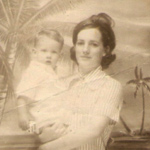
 The photo is my son and myself. Now days you can get a photo made to look old like this one. This photo was taken when this was the new look.
Harry S Truman was president when I was born and world war II had ended. I grew up in a time when lunch was put in a brown paper bag and a sandwich was wrapped with wax paper. There was no such thing as pantyhose, we wore stockings that attached to the rubbery clippy things that attached to the girdle. Convenience stores were not common and when we took a trip we packed a picnic basket because many places did not have fast food. Highways had places to pull over and stop, some with picnic tables. Read more ....
Comments On Article: A Change Of Plans Again
Becky Sue,
I feel we were raised by the same person! Right down to having the same name Becky Sue/Becky Dawn!!! When I went to college i was called Rebecca by everyone else. The description you gave of a holiday meal was ours exactly!! I’m sure my Mom also felt trapped by circumstances, she was essentially forced to stay home after having children. Nothing maternal or domestic about my Mom, whatsoever. A good book and a pack of cigarettes was her idea of a grand day! I also was reading well before I started school. And I was fortunate in being able to go to college and have a career. I became a physician and my Mom was terribly proud of my achievements. I always loved cooking, sewing, knitting, gardening and my Mom could never understand why I would “waste my time” on such things! I spent a lot of time with my wonderful Grandmother
Rebecca
Becky Sue K, no kidding, that I just didn't pick up this book, The Wartime Kitchen, at the thrift store yesterday!!!
According to Smithsonian, colored lights in Christmas trees were affordable and pretty everywhere by the 1930s. People put tinsel on their trees, made of actual lead! But during the world wars they wouldn’t have been able to purchase tinsel. I was researching lights on Christmas trees after seeing several articles about how current design trends have seeped the color out of our lives. More and more people choose white lights only, muted colors, and even monochrome decor on their trees.
I won’t be joining the 1940s study, mostly because I’ve decided we will be living “timeless”. We will pull the good from the past and mix it with the good of today. I’m alarmed by all of the politically coded talk I see in the news, people harkening back to “better” times and “simpler” times when they were only better for some people — mostly white people, mostly men, mostly middle class or affluent. I realized I don’t need to pretend to live in a certain era to reap the benefits of the knowledge that comes from the past — it is with me in the present.
I refuse to see the present as a scourge that must be eradicated. People are people and always have been, each aging generation bemoans what is happening with the “youth of today”, each new technology is embraced by some and shunned by others. Throughout time there have been hard times and things that were alarming. I’m not saying things aren’t disconcerting, just that the most recent things that are disconcerting are simply that — the most recent things. I worry about young people and social media. My parents worried about young people and the trend to “live together” unmarried. Some of my grandparents worried about young people and the hippie movement. My older grandparents worried about young people and rock and roll. My great grandparents worried about young people and the cinema. My great great grandparents worried about young people leaving the farm — it goes back and back and back.
My paternal grandmother was one of my best examples of a person who lived through many changes and yet could really see that people are people throughout it all. Here are some words I wrote for her eulogy:
I learned so many lessons from Grandma over the years, and I want to share some of the most important ones with all of you because her wisdom is worth sharing:
There are stories your parents didn't tell you, and some of the stories they told you they got wrong. These stories are worth hearing, so make time to listen.
A person needs meaningful work. For some women that doesn't mean staying home and caring for children. For some women ironing is boring. Don't judge the women who choose not to stay home and mother 24/7. Don't judge the women who do.
Things don't really change all that much. “Way back when” girls decided to wear the same outfit to school on the same day; couples got divorced; women worked; elders were shocked; people had housecleaners; teenagers drank alcohol, smoked, drove too fast, and got pregnant. Technology changes; people don't.
Frugality will win in the end...unless you are fabulously wealthy from the beginning you'd better learn the skills you need to get you through the lean years, and to take you into retirement. Let people laugh when you cut corners, let them say you're cheap, and take comfort in a paid-for house and sufficient retirement savings.
Give of yourself. Donate your time and talents. Get involved, because you can make a difference.
Friends are more important than you can possibly think when you are young and busy with the work of raising children. Take time to cultivate new friendships and to keep up with old friends. Never tell yourself that there isn't time; we need friends as much as we need family.
Do what you need to do to keep your family healthy, with strong ties. Love your children unconditionally and accept them for who they are. Don't lose sight of the big picture while fighting over bed times, dirty hands, and too-loud music. You are tending the saplings that will grow to protect you in your old age.
And finally . . .
You will hold your child's hand, and your grandchild's hand, and the time will come when you need them to hold yours. It's precious.
It was from my paternal grandparents, and especially my grandmother, that I learned simplicity. Unlike my parents, they shunned debt — they used layaway frequently. They lived in a small, simple house when I was a child, and moved to another small, simple house after retirement (to a lower cost of living area). They ate simple foods. They were frugal and practical. Their furniture was the same furniture they had purchased early in their adult lives — the only things I ever saw replaced were the sofa and chairs (infrequently), and the mattresses. They never traveled to another continent. Most of the their vacations involved camping. They were able to retire in their 60s. But my grandmother never baked a loaf of bread in her life. She worked full time from when was a young widow until she was in her early 60s. She could sew but didn’t love it — it was practical for her. My grandfather was an early adopter of all sorts of technology, when he could afford it. They loved watching television.
I drifted away from simplicity after the first few frugal years of marriage, but the example was there and I came back to it when I realized the consumer treadmill wasn’t making me happy, and indeed, had gotten me into debt. At some point I looked to their example and realized I could follow their ways and be able to retire too. I just couldn’t do it by moving to a more expensive house, buying new furniture or clothing all of the time, or traveling to Europe for vacations.
Retirement is just a few weeks away for my husband. Without my grandparents’ example he wouldn’t be retiring now, and without the lessons I learned from them we wouldn’t be confident we could make it work. They taught me to be content with peanut butter toast and egg salad sandwiches. They taught me a three bedroom house without a separate family room is plenty of house for a family. They taught me that owning my house outright should be my goal. They taught me that camping in the mountains is a fine vacation (and there are photos of me doing just that with them, as a very young child). Most of all they taught me that learning to not need a big income would lead to freedom
I totally agree with everything you said above, Kimberley F. - to be satisfied with what you have is priceless.
Grandma Donna wrote,
Crunchycon, I am not sure the name of the field my Father was stationed, the book I thought the his discharge papers are in is not the one, I think that I put it in a box with some photos. I will let you know when I find them. That is a nice thought that possibly they knew each other. (heart)
Rebecca H and Becky Sue, your similarities are remarkable!
A note to all, our history studies have always been and continue to be to find our ancestors strengths and to learn their skills to help us in the everyday things we do and the difficult times we experience or may experience. We cannot change the past but we can learn to do our best to not repeat their mistakes. For Charles and I, the studies make us happy by keeping us connected to our ancestors that came before us and our good memories alive in our hearts and minds. The benefits that Charles and I have from our studies have helped us in so many ways, we paid off our home and car and learned to live frugal and most importantly have kept us from wanting for a bigger home or a newer car and to find comfort in the simple things in life.
Dee W, I am so sorry! My email is sending comment notices to my junk mail again. I have corrected that several times already.
I found this recipe at Ourheritageofhealth.com and saw a similar one elsewhere.
3 cups flour or bread flour
2 tablespoons molasses or sugar (I use sugar)
1 teaspoon salt
1/2 cup active sourdough starter
1 cup warm water
Combine flour and salt in a bowl or in bowl of stand mixer. Stir to combine.
Add sugar or molasses, starter, and water and mix well. It will be sticky.
Knead in the bowl by hand or with dough hook for just a couple of minutes. Dough should still be sticky.
Grease a 9x5 loaf pan and scrape dough into the pan. Cover with a damp cloth touching the top of the dough then cover the damp cloth with a dry one while rising. Leave the dough in the pan sitting on the counter, covered, for 8-14 hours depending on temperature of the house, until the dough is risen and leaves an impression when lightly pressed with two fingers.
Preheat oven to 350F. Uncover bread and place in oven for 40-45 minutes until browned and internal temperature is 190-200F. Remove from pan and let cool completely before slicing or it will be gummy. Store in cloth a day or two on the counter. I slice it all when cooled and freeze most of the slices with waxed paper between them. This makes a nice sandwich loaf.
I didn't grow up during the Great Depression however my mother did. My father died when I was 7 yr old, so we had limited money. My mother made all our clothes, put up wallpaper & shutters, and made curtains, cooked from scratch, etc. Even though it was the 1960's she used some of the techniques from earlier generations.
Gdonna, your childhood bedframe is lovely. Do you still have it? I still have my parents' early American maple bedframe & dresser. I slept on the bed for many years. It is time to pass it on if any family members will take it.
What is the name of your jade green cup & saucer? It doesn't look like Fiesta Ware. Was it popular in the 1940's? I don't remember my grandmother having anything like it.
Thank you. Becky Sue K, for the book recommendations! I just ordered Grandma's Wartime Kitchen. Initially, I had several in my cart at ThriftBooks (best prices overall - I searched several sites), but pared it down to only one. I am working on exercising more frugality!
Grandma Donna Wrote, Laurel K-2 the bed frame is a replacement found in a salvage store but my chest of drawers, dresser and night stand are my original. My mother gave my bed away to someone that needed a bed after I married. Later and many moves through life that she made I ended up with my original bedroom furniture minus the bedframe .
The name of my Jade Green tea cup and saucer is Jadeite green. McKee Glass Company started manufacturing Jadeite in 1931 and 1932. It was made during the great depression as inexpensive kitchenware. Other manufacturers such as Jeanette, and fire king manufactured the Jadeite. Anchor Hocking started producing the popular Jade-ite in the1940s. I have two styles of the green ribbed and the Alice Jadeite which is my favorite. I do not have many pieces of Jade-ite.
I love the change to the 1940's. I won't be making many changes to my life at present (I'm making some other big changes right now), but will follow with the study. This year (2025) in particular, the 1940's are hitting me as important to study. I have Polish heritage and have recently started on a journey to convert to Judaism. So this study is important to me on many different levels. The frugality, ingenuity and teamwork shown have always been fascinating to me, but now I can add on the layers of compassion, self-less sacrifice and bravery that were demonstrated by survivors and those that helped them speaks to me even more.
Grandma Donna Wrote,
Some exciting news, for the previous 1940s studies I was limited to study the newspapers from the United States. This new study I will also be studying the news from London England as I am able to study the Daily Herald and a few other sources. You can do this too from online newspaper sources.
During the other ww2 studies I was aware that the rationing started earlier and was much more severe in other countries but I had no access. My dear friend Judi was wishing she had more information for rationing in England and Australia and I never could find this information.
I am now searching for this information. I have just finished reading an article from 1939 about the rationing and will compile some stats so that we will be able to include this for our study.
When I do blog posts I do not know the legality of posting the actual articles due to copywrite, but I can write about it. I do know that in 1949 the article was talking about five ration books and I will not put much here in the forum at this time, but along the study if any of you have extra information about the actual rationing facts they can be shared in the forum. Rationing changed all during the war so it is important that we follow the time we are in not the rationing at the beginning or towards the end of the war. Rationing continued much longer for different parts of the war after the war was over.
The rationing is not all about food, it is so much more. Electricity, fuel, fabric, metal, tires, bicycles, typewriters and all kinds of thing. Should be an interesting year. :)
In Germany, ration cards for bread, milk, fat, and eggs had been in place since 1915, since the First World War. From 1916, rationing was extended to clothing. In 1939, shortly before the outbreak of the Second World War, rationing was tightened to ensure basic supplies.
After the ww2, Germany was divided. While the western part (later the Federal Republic of Germany) received American aid for reconstruction, the Soviets dismantled everything usable in the eastern part (later the German Democratic Republic) and transported it to Russia as reparations. This further weakened the East. Food and fuel continued to be rationed for years after the war. For example, ration cards for potatoes were not abolished until 1966. Women raised the children and rebuilt the country. Until the end of the GDR, everyone who could had a small garden, and many kept rabbits or chickens to supplement their food supply.
Industrial production in the East rose slowly, and to bring in crucial funds to purchase raw materials, the state sold a large portion of its manufactured goods (Machines, televisions, cars, washing machines, sewing machines – simply anything that could be sold, including a significant amount of food) abroad.
The population was dissatisfied with this situation, which led to a large popular uprising in 1953 that was suppressed with the help of the Soviet army.
@Becky Sue K: thank you for sharing your books, they look so very interesting! And I absolutely LOVE the 1940’s House and own it on dvd. I am so excited to know there is a book as well and was able to find a copy on thriftbooks. Thank you!
@Gdonna: thank you for keeping this a politics-free place. I absolutely love this blog and forum and the fact that it is a safe respite from all of that.
For anyone interested in learning more about rationing in the U.K. during WWII, this website offers a wealth of information. It also has over 200 wartime recipes. If you have seen this website before, it looks like she has added to it, as it now has the Ministry of Food leaflets. There are also now two vintage 1940s cookbooks on there. There is also an article and a video about rationing. She has really added to the website!
Grandma Donna Wrote,
Sibylle M,
Thank you for describing what the people of Germany went through during ww2 in a personal way for us to understand much that we cannot find in books. We learn the effects on all people no matter where or what started a war.
We are taught about love and to love others, and we think of love as something we feel to a mate or a child but love is also made up of forgiveness and caring. Unless we finally stop blaming we can never heal or experience peace.
Many times in history we can see that after war, enemies become allies. This should tell us that a war is often started by someone or few while the many are just waiting to be human again.
Thank you for your kind and wise words.
Sibylle M,
My great-grandfather was a German immigrant, (I'm in the U.S.) and until WWII, there were German-speaking-only churches in my home town, which had a sizeable German-American population that was fiercely patriotic for the U.S. while maintaining sympathy for the "old country's" people. I know that where I grew up, people understood that not all Germans were Nazis. They understood that many Germans suffered greatly during those years.
My dad served in the Pacific in WWII against Japan. Decades later, my sister and her family hosted a Japanese exchange student for two years, and they remain close to this day. It was moving to see my elderly parents celebrate Christmas together with the exchange student and my sister's family.
I second her thanks for your post.
One set of my great grandparents were German immigrants, who lost a lot of family members back home to WW2. Some fighting in the German army, and others when the city of Essen was bombed. Their son (my grandpa) went into the American navy just out of highschool, but the war ended while he was still in training. He was stationed in Japan afterward, working on infrastructure.
Every country is guilty of something against someone else. I'm afraid humanity has not evolved much since we started. But we can hope that as we become more aware that we are more alike than not, this type of behaviour will abate. Many people tried to tell Russia this when they first invaded Ukraine a few years ago. Invading people is so outdated and barbaric.
It is a good Joan, that your area was aware not to paint all with the same brush. Many people were not in this country. In California where I live, there were many people who took over Japanese farms and ran them for their Japanese- American neighbours when they were put into camps in Arizona and similar places. But many Japanese were scorned and cheated when they came home.
Yes, it's true: No one wins a war. Even the so-called victors suffer heavy losses that no one can ever make up for.
That's why it's so important that we respect each other, exchange ideas, and get to know each other in some way, even if this can only be done electronically.
Thank you, Grandma Donna, for creating this shared platform for us!
Tea S, my grandfather was also stationed in Japan after WWII. My grandmother kept all of his letters to her and my mother has them now.
My mother was a homemaker and thrifty by necessity. She gardened, canned, cooked from scratch, baked and sewed most of my and my sister's clothing. We never went hungry. By contrast my best friend's (2 days younger than me) mother was exactly how you describe you mother! They did go hungry. We lived in very similar situations on small farms. The difference was in my dad's worth ethic and my mother's homemaking skills. Friend's mother was a beautiful seamstress; however, she did not do any gardening, did not make butter, bake bread etc. She had grown up in a wealthy home and resented the poverty of small farm/small town life. I once was at their home when supper was two pieces of unbuttered bread with one slice of bologna and water to drink. Supper at my home would have been meat, potatoes, veggies, bread/butter, milk and some kind of homemade dessert topped by whipped cream.
My friend and another girl in my class had big bellies and were called fat. As an adult I realized they were suffering from malnutrition.
I think the key to 1940's cooking is keeping meals simple. My grandmother always had homemade beet pickles and apple butter on the table, and every meal included meat and potatoes. Primary veggie would have been home canned green beans.
I have a1938 cookbook that I found in an auction box, came with the purchase of a new Home Comfort cookstove, Croquettes were featured as a way to use up leftover meat. The recipe calls for 2 cups minced meat, fish or vegetables. There are also recipes for Cheese Croquettes and Rice Croquettes. There are a lot of "leftover" recipes. This book also has colored pictures.
The picture of the biggest fanciest stove that probably cost too much for many to purchase is spectacular with six lids, warming ovens, oven and water reservoir weighing in at 530 lbs. Finish is "vitrified enamel" whatever that means! The 1937 model is similar to what I always think about when I hear "cookstove" but the 1938 model is much more modern looking.
Dear Grandma Donna,
I cannot tell you what a joy it has been to discover your blog through Rhonda Hetzel. I spent the last month of last year devouring your writings, especially from the past 12 months, and I followed your 1943 study with great interest. I’ve been fascinated by the 1940s for a couple of years now, and funnily enough, it’s something that began when I was a teenager. I was a bit of an oddball back then, watching Rodgers and Hammerstein films instead of modern ones, and sewing my own clothes in 1940s styles.
Now, at 38, as a mother of two little ones here in Australia, I find myself returning to those earlier loves with renewed joy. I’m so thrilled that you and Charles are doing this 1942 study. I’ve been telling my husband all about your history projects, and as someone who also has a deep appreciation for old ways, he said, “Let’s jump in.” And so we have.
We’ve been having such fun gently shaping our home and habits around 1942. With two small children (a four-year-old and a two-year-old), I’m very much looking forward to reawakening my sewing skills and making them some clothes. I’ve also been cooking almost exclusively from 1930s and 1940s recipes, and I’m loving the simplicity and rhythm it’s bringing to our days.
In the spring, we planted a big victory garden, and now, in the height of summer, it looks like we’re in for a bumper crop of tomatoes, peppers, eggplants, and beans. I’ve got some learning ahead as I prepare to can and preserve our harvest, but I’m feeling so inspired.
Thank you for the incredible work you do and for sharing your life so generously. This truly is a very special corner of the internet, and I’m so grateful to have found it.
Warmly,
Isobel
Grandma Donna wrote,
Isobel P, I am so happy to read that you found my blog and that you enjoy the history studies. Charles and I feel like these studies have helped us so much and give us much to look forward to. It has calmed our home and our pets and put so many things into a better perspective of the direction of our life and how we were just doing what everyone else does until we went back to basics and then started trying to resemble our generations before us rather than what there is today.
I am happy that you are here and very happy so read that you, your husband and children are taking part in the studies. :) Grandma Donna
| « Previous Page | 1 |

Loading more pages
NEW! Join the mailing list to get email notifications when new articles are posted to our site.
Thank you for joining!
IMPORTANT!
You were sent an email to confirm your subscription to our mailing list.
Please click the link in that email to confirm or you won't be added.
If you have not received the email within a few minutes please check your spam folder.